

This post has nothing to do with the DeBoise family and its ancestors, other than my connection to the family through marriage. This is about my family.
In the 1970s, my husband and I took my father-in-law, James DeBoise, to Salem. We did the normal tourist stuff – the Witch Museum and the House of Seven Gables. I also walked around cemeteries looking for tombstones of my ancestors. I knew I had family living in the area in the 1600s. I also expected that they had to be affected by the hysteria around witches, but I had no idea how.
I do believe that when people are ready to be found, they will be. A few years ago I found that information, and was amazed, and saddened. This is one of the stories of my family.
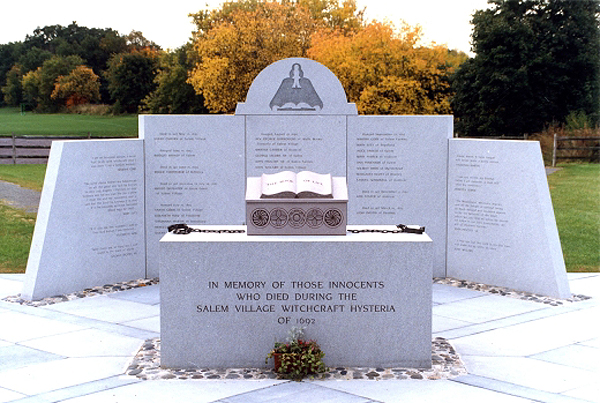
Salem Village With Memorial legendsofamerica.com
The ancestors of both my mother and father were very involved in the events of the 1600s. Some were accused of being witches, jailed, and participated in hearings before judges and juries similar to what was depicted in the play and movie The Crucible (Arthur Miller wrote the play in 1953. It is based on the Salem Witch Trials, but there was some liberties taken with the story.).
The Salem Witch Trials occurred in the towns and counties surrounding Salem, Massachusetts during 1692 and 1693. By September, 1693 when the last of those accused were released from jail, almost 200 people had been jailed, 24 had died, and 55 were coerced into confessing to practicing witchcraft.
The Accused
Jane Lilly is my 9th paternal great grandmother. Jane is the second wife of George Lilly. George was born in England and living in Reading, Essex County, Massachusetts by 1659. Jane was born in either Massachusetts or England. George married Jane (her maiden name is not known) in 1667, and they had three children – George Joseph, Reuben, and Abigail. Jane was 46 years old when she became a widow at George’s death in 1691. She was still living in Reading in 1692.
Jane was accused of witchcraft, along with Mary Colson, and examined by his majesty’s justices in Salem on September 2, 1692. Her accusers included Mary Warren, Elizabeth Booth, Susanna Post, and Mrs. Mary Marshall (wife of Edward, of Malden). She was accused of afflicting them and causing them to fall in a fit as she looked at them, and causing the fit to end with a touch of her hand. She was also accused of setting William Hooper’s house on fire and killing him. Jane denied all of this, saying if she confessed any of what she was being accused of she would be denying the truth and wrong her own soul. Jane was imprisoned in the Salem jail (Witches of Massachusetts http://www.legendsofamerica.com/ma-witches-k-n.html).
On December 8, 1692, her sons George and Reuben Lilly, who were husbandmen (farmers) in Lynn, along with John Pierson, pledged 200 pounds of their property and goods for her release, guaranteeing her appearance at the next Middlesex Court hearing for trial. On the same day George also pledged, along with John Pierson, 200 pounds to free John’s sister, Bethia Pierson Carter, who was also accused of witchcraft and was imprisoned (Salem Witch Trails: Documentary Archive and Transcription Project. http://salem.lib.virginia.edu/texts/tei/swp?term=John%20Somes&div_id=n28.1&chapter_id=n28). On January 31, 1693 the Grand Jury in Middlesex County returned an indictment for Jane of ignoramus, meaning there was not enough evidence to indict her of witchcraft.
Jane’s children, Reuben and Abigail, both died in 1698. Her son, George, went in front of the Reading selectmen in June 1701 and refused payment for the keeping of his mother. I am not sure if this had something to do with restitution from her jailing, or if it was for caring for her when she was destitute. Although I do not know when Jane died, it was probably in the early 1700s. By 1707, George (my 8th great grandfather) was a resident of Scotland, Windham County, Connecticut where he was one of the early founders of the community and became a prominent landowner of the area.
Frances (unknown) Hutchins is my 10th maternal great grandmother. Frances was born about 1612 in England. She married John Hutchins in 1637. He was a carpenter, a partner in a sawmill, and a farmer. (Frances is referred to in many records as Frances Alcock, who immigrated as a servant for the Richard Drummer family on the Bevis in 1635. However, there is no proof that Frances, wife of John Hutchins, is the same Frances Alcock.)
Frances was first arrested in 1653 for wearing finery – a silk hood. In 1650, the General Court had passed a law prohibiting the display of finery by persons “of meane (sic) condition” defined as persons whose property was valued at less than 200 pounds. For women, finery included silk or tiffany hoods, ribbons or scarfs. Frances was acquitted because “upon testimony of her being brought up above the ordinary way,” and was entitled to wear the finery, while her friend Mrs. Swett was found guilty and had to pay ten shillings . John Hutchins died in 1685, leaving Frances a widow when she was about 73 years old.
Widow Frances was 80 years old when she was arrested August 19, 1692 on the charge of witchcraft, and transported to and imprisoned in Salem. Her accusers include Timothy Swan of Andover as well as Ann Putnam, Jr. and Mary Walcott of Salem Village. On this day, five accused witches were hanged in Salem. Imagine her chained in the horse drawn cart as it drove by the gallows on her way to jail.
She was imprisoned until December 21, 1692 when she was released on 200 pounds bond posted by her son Samuel Hutchins and John Kingsbury. There are no records of a trial or indictment. Frances died on April 5, 1694.
The Towne sisters are well known in this drama, as all three were accused of witchcraft. A monument in Salem honors their sacrifice. Edmund Towne, the husband of Mary Browning, my 8th paternal great grand aunt, was their brother. Rebecca (Towne) Nurse and Mary (Towne) Easty, were convicted of being witches. Rebecca was hung June 19 and Mary was hung September 22, 1692.
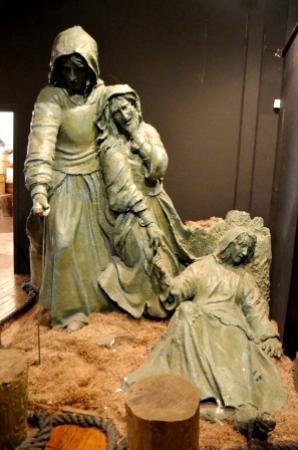
The Towne Sisters – Mary, Sarah and Rebecca at Salem Wax Museum tripadvisor.com
Sarah (Towne) Cloyce was accused of bewitching Edmund and Mary’s daughter, Rebecca. Widow Mary Browning Towne, along with four of her children, was called as a witness against her sisters-in-law Mary and Sarah on September 6, 1692. She responded the following day asking to be excused from testifying in that she and her children were very weak and could not get out of bed. She was summoned again on September 8. There is no record that she testified against her sisters-in-law. There was no credible evidence for finding Sarah guilty of practicing witchcraft, and the Grand Jury dismissed charges against Sarah on January 3, 1693. However, she was not released from prison until her husband, Peter, paid her fees from the imprisonment (Records of the Peabody Institute Library, Danvers, Mass. as referenced by Phipps Family Pages and hosted on RootsWeb: http://freepages.genealogy.rootsweb.ancestry.com/~walkersj/EdmundTowne.html). (Sarah Cloyce is the main character of the PBS movie “Three Sovereigns for Sarah”)
Accusers
Before the Salem Witch Trials, my 9th maternal great grandmother, Joanna Lee Sleeper, wife of Thomas Sleeper and a resident of Hampton, New Hampshire, twice accused, in September and October 1656, Goodwife Eunice Cole of witchcraft. Joanna, along with Sobriety Martson, claimed that while talking about Goodwife Cole and Goodwife Marston’s child, there was a scraping against the boards and windows of the house, caused by Goodwife Cole. It was concluded if an animal had made the scraping, it would have left marks.
Goodwife Cole was found guilty of witchcraft and sentenced to be whipped and to life in prison in Boston. She was released after 15 years and the town of Hampton was ordered to support her. Shortly after she was released, she was again accused of witchcraft and once again imprisoned. After a few months she was found not guilty and sent back to Hampton, where she died in poverty (Nutfield Genealogy: http://nutfieldgenealogy.blogspot.com/2016/04/surname-saturday-sleeper-of-hampton-new.html).
It is October and children and adults are getting excited about celebrating Halloween. Salem celebrates this holiday throughout October, integrating the history of the witch trials in their celebration to promote tourism. However, this celebration seems to be less about the horrors of this time period and the effect it had on families, and more about dressing in costume and having fun. I’m all for having fun, but to me the hysteria about witchcraft is a sobering time that had a very real impact on my ancestors. In addition to the hysteria, so much of what went on during this period had overtones of “politics”, “getting even”, and singling out those who were different.
Imagine these accused women, most of whom are older women, wearing heavy iron hand cuffs and leg fetters, and chained in their jail cells. Frances Hutchins was 80 and Jane Lilly was 47 when they were jailed. They were kept in prisons that were damp and dark. They were tortured as their jailers sought to have them confess to witchcraft. Their jail cells were cold in the winter, hot in the summer, infested with lice and rats, and smelled. They slept on straw, if they had any bedding at all.
The Salem Dungeon and Jail was located near the North River, and was often subject to flooding. And to add insult to these indignities, families were charged for all costs of imprisonment. Even when the accused were found innocent, they were not released until their costs of imprisonment were paid (Procedures, Courts & Officials of the Salem Trials. http://www.legendsofamerica.com/ma-salemcourt2.html).
I will never know the full impact this period of history had on my family. But I can respect, and empathize with what our ancestors went through; and share their experiences with future generations so that they also know the part their family played in our nation’s history, as dark as this chapter is.
Enjoy October. I’m always amazed each year at the beautiful fall foliage. It’s like God dribbled bright colors of paint on the trees. My favorite time of the year.
Until next time….
Teri
 Climbing Our Family Tree: The Ancestors of James DeBoise and Ruth Andrews