Notable Ancestors of Ruth Andrews DeBoise: Richard Warren, Samuel Lincoln, and Reverend Peter Hobart

One of the genealogy shows on TV that I enjoy is “Who Do You Think You Are”. The show is on TLC on Monday nights. They feature a celebrity and trace their ancestors. The celebrities who are featured have an interesting ancestor that makes for a good story. If they were to pick non-celebrities, the descendants of Ruth Andrews DeBoise would have many ancestors with fascinating stories to tell.

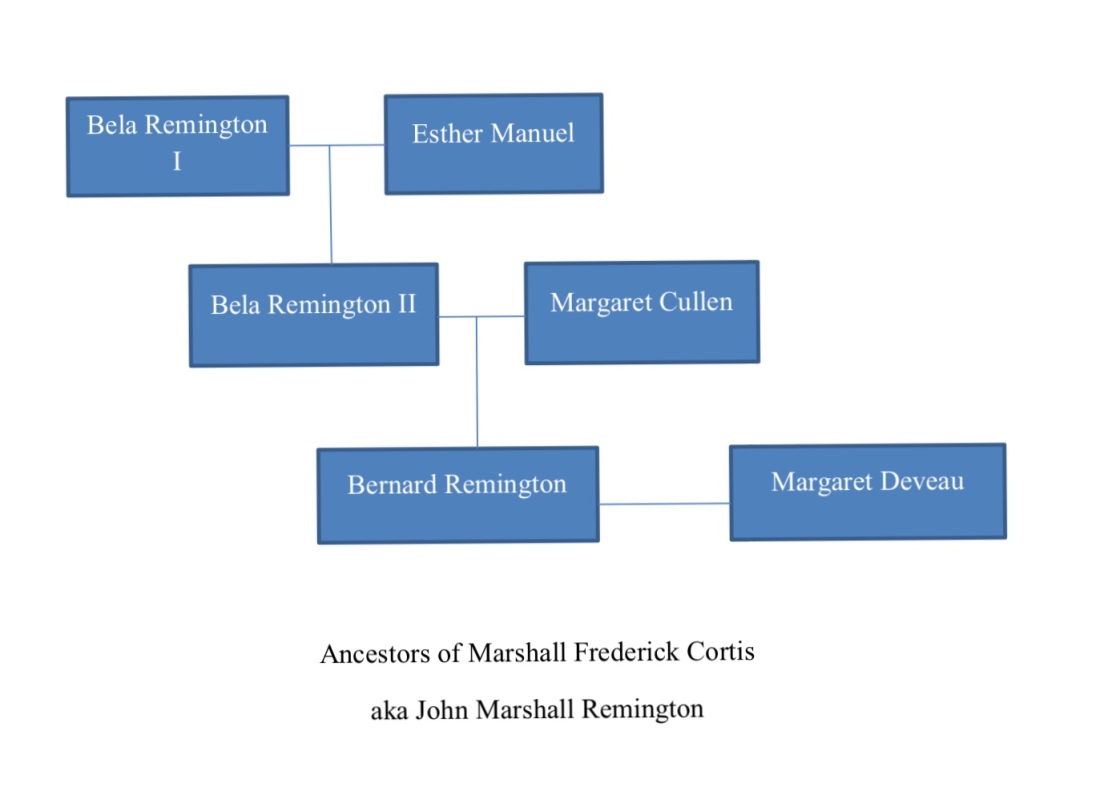
I am going to introduce you to Richard Warren who was one of the original passengers on the Mayflower; Samuel Lincoln who is also the immigrant ancestor of President Abraham Lincoln; and Reverend Peter Hobart who was the first minister in Hingham, Massachusetts. Each of these men and their families are well documented, and you can find out more about them with a “Google” search. To find out how they fit into the family, refer to the Pedigree Chart on the ancestors of Marshall Frederick Cortis.

Pedigree Chart for Marshall Frederick Cortis ♥

Richard Warren

Richard Warren is Ruth Andrews’ 8th great grandfather. His fame came from being one of the original passengers on the Mayflower. Richard was born about 1578 in England, and is thought to have been a merchant while in England. He married Elizabeth Walker, the daughter of Augustine Walker, around 1610.

He was one of the 102 passengers who departed Plymouth, England in September 1620 to journey to Virginia in the New World. He left his wife, Elizabeth, and his five daughters in England. The ship was blown off course and arrived in the Harbor of Cape Cod in November 1620.

MAYFLOWER-II_Photo-courtesy-Plimoth-Plantation-315x472

Mayflower II

There is a replica of the Mayflower, which I have visited several times. The ship is relatively small. Imagine being packed with 102 passengers and 30 to 40 crew members, plus food and belongings, and spending 90 days at sea. Fall and early winter are not the easiest times to sail in the Atlantic, and this journey was rough.

Two persons died on the journey – a passenger and a crewman – but many were sick. Winter is about the worse time to arrive in New England. The passengers were not prepared for a harsh New England winter, and about one-half of those early arrivals died during that first winter. Richard survived.

Richard was one of the signers of the Mayflower Compact, which was signed on November 11, 1620. This was the first governing document of Plymouth County, Massachusetts.

In 1623, Richard’s wife and five daughters arrived from England on the ship Anne. He and his wife then had two sons to join his daughters. Richard died in 1628. His wife lived into her 90s. All the children married and had children. Some of the notable descendants of Richard Warren and his wife are Franklin Delano Roosevelt, Ulysses S. Grant, and Orson Welles. Ruth Andrews is a descendent of his daughter Mary.

If you haven’t already done so, go to Plymouth, Massachusetts and visit the Plimouth Plantations. The Mayflower II, a replica of the Mayflower, is currently being restored at Mystic Seaport in Connecticut. It is expected to be completed sometime in 2019, and before the 400th anniversary of the 1620 arrival of the Mayflower. Once restored, it will be docked again in Plymouth. These are great living history museums which will give you some insight into what the voyage and early life in the New World might have been like.
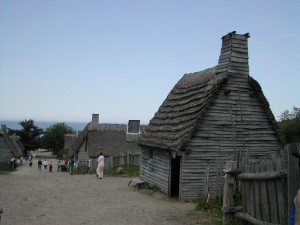
Plimouth Plantations 2003

Plimouth Plantations

Some sources for more information on the Richard Warren family include:

Caleb Johnson’s Mayflower History.com http://mayflowerhistory.com/warren/

Richard Warren Wikipedia https://en.wikipedia.org/wiki/Richard_Warren

Samuel Lincoln

Samuel Lincoln is another one of Ruth Andrews’ 8th great grandfathers, and is Abraham Lincoln’s 4th great grandfather. Samuel was born about 1622 in England. He sailed on the ship John and Dorothy in 1637 to New England. The ship’s passenger list has him listed as Samuell Lincoln, servant, age 18, destination to New England to inhabit. He was traveling with Francis Lawes and his family. Mr. Lawes was a weaver from Norwich, England who settled in Salem, Massachusetts. Samuel was thought to be apprenticed to him to learn the trade of weaver. He was probably younger than 18 when he sailed.
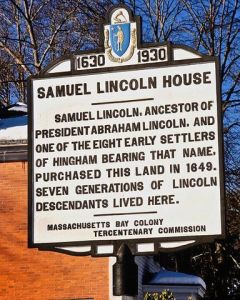
samuel-lincoln-house_large
Samuel first settled in Salem, and then moved  to Hingham, Massachusetts where his older brother Thomas was living. Samuel married Martha Lyford in 1649. Together they had eleven children. Samuel helped to build the Old Ship Church in Hingham, and attended services conducted by Reverend Peter Hobart. Samuel died on May 26, 1690. His wife, Martha, died three years later in 1693.

Abraham Lincoln is descended from Samuel’s fourth son, Mordecai. Ruth Andrews is descended from his daughter Mary.

Reverend Peter Hobart

Reverend Hobart is another of Ruth Andrews’ 8th great grandfathers. He is known for establishing the Congregational Church in Hingham, Massachusetts, and serving as its first minister until his death on January 20, 1679.

Peter was the son of Edmund and Mary (Dewey) Hobart, and was born October 13, 1604 in Hingham, England. He attended Magdalen College, Cambridge, England where he received both Bachelor and Master degrees, finishing his studies in 1628. He then entered the ministry. Peter spent most of his adult life in the ministry, both in England and then in Hingham.

Peter married Elizabeth IBrook, and in 1635 left England with his wife and four children to join his father in Charlestown, Massachusetts. He arrived June 8, 1835, and by September 1835 he was living in Hingham. He was Hingham’s minister from 1635 until his death in 1679.

His wife, Elizabeth, died in 1645. In 1646 he married (2) Rebecca Peck. Rebecca is the 8th great grandmother of Ruth Andrews. Ruth is a descendent of their son, David Hobart. At the time of Peter’s death, fifteen living children were mentioned in his will. There must be many descendants from the Reverend!

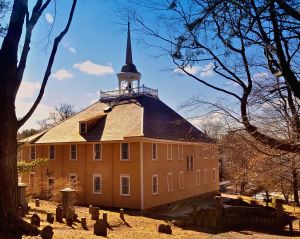
Before Peter died, his congregation was planning to replace the current church. The Old Ship Church was built in 1681, and is the only surviving Puritan 17th century meeting house, and oldest continuously operating church in North America. The inside of the church looks like the beams of an inverted ship, hence the name.

I must see this church and am going to take a trip to Hingham on a nice warm spring day. Google pictures of Old Ship Church to see how fantastic this church looks.
OldShipChurchView

Old Ship Church

Reverend Hobart started a journal in 1635, recording important events in his life and that of the community, including births, deaths and marriages. The Reverend continued the diary until close to his death, and his son David continued recording events after his father’s death. Amazingly, this diary has been scanned, and is available for viewing on Ancestry.com! It is used as documentation for many of Hingham’s earliest town records.

I bet these three individuals had no idea they would play such a role in the development of our country, and that their descendants would have such an impact.

Best wishes for the holidays and the New Year!

Until next time,
Teri
The Bela Remington Family of Hingham, Massachusetts

I have taken a long break from telling stories of the Remington’s and the families associated with them. I started writing about Bela Remington many times. But I would get distracted, and do a little more research. The Remington family tree branches stretch into the earliest of New England’s settlers. That means there are many generations and over 300 years of history just in New England! That’s a lot of history!!

The search has been interesting. I found family who served in the Revolutionary War. Another direct ancestor was one of the earliest ministers in Hingham, and many ancestors played prominent roles in the establishment of Hingham. I also learned that the descendants of Marshall Cortis are related to Abraham LincolnAbe Lincoln is a cousin although many times removed! That is pretty cool. And we can’t forget our Mayflower Ancestor Richard Warren. I have only scratched the surface in looking at this family. I will share some of the stories I have found and encourage you to do your own searches to see what else you can find.

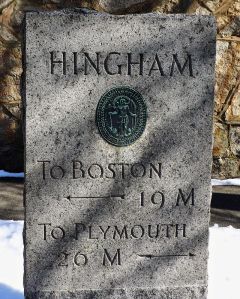
Hingham Marker
I have lived in New England for over 40 years, and have never been to Hingham. I’ve heard of it, but really didn’t know anything about the town. Hingham, Massachusetts is located on Boston Harbor on the South Shore of the Greater Boston Metropolitan area. It was first settled by English colonists from Hingham, England in 1633. Most of the early settlers were Puritans, leaving England because of religious dissent with the Anglican Church. The ancestors of Ruth Martha Andrews DeBoise and her father, Marshall Cortis, were among those early settlers.

Thomas Remington was the first Remington I found in Hingham. He was listed in marriage records for March 1688 when he married Remember Stowell.  Remember’s family was in Hingham in the early 1630s. Thomas was probably not the immigrant ancestor, but I have not been able to verify his parents. He is often confused with another Thomas Remington who was also born in Massachusetts about the same time as our ancestor. The other Thomas moved with his father to Suffield, Connecticut where he died. Our Thomas was still fathering children after the Suffield “Thomas” was deceased! Six generations later, the grandfather of Marshall Cortis was born – Bela Remington II.

ancestorsRemington

Bela Jr. (II) was born in May 1824 in Hingham, the son of Bela Remington Sr. (I) and Esther Manuel. It was not quite 50 years since the United States declared its independence from England and fought the Revolutionary War. There was a contentious presidential election in 1824. Andrew Jackson had the largest number of electoral and popular votes among the four candidates running for office, but he did not have a majority of electoral votes. The House of Representatives was left to decide who the next President was going to be. Politics have never been nice. Favors were called in by Henry Clay, a leader in the House, and John Quincy Adams was selected as the sixth President of this new Republic.

Bela Sr. was the son of Elisha Remington, Jr. and Margaret Stowell. Bela Jr.’s mother, Esther, was the daughter of John Manuel, who had emigrated from France, and Esther Lewis, whose ancestors are among the earliest settlers of Hingham. Esther Lewis traces her direct ancestors back to Samuel Lincoln, who is also a direct ancestor of Abraham Lincoln.

Bela Jr. was the oldest of five children of Bela Sr. and Esther. His mother died in 1839 when he was 15 years old, and his father died two years later. Bela Sr. left land and an estate, which was sold off a little at a time over the next few years to help care for the  children. The youngest child was 5 years old at his father’s death. Esther’s brothers, John and Robert Manuel, became guardians of the youngest children.

Bela Jr. married (1) Bridget Crehan on October 24, 1848 in Boston. Bela was 24 years old and Bridget was 22. Bridget was born in 1826 in Ireland, and was 20 years old when she arrived by the ship Agnes Gilmore, which sailed from Liverpool, England to New York City. Following arrival in New York, she went north to Boston, where many other Irish immigrants were settling.

About the time that Bela married, he took custody of his brother Charles, who was then 13 years old.  Bela worked as a milk carrier and farmer. In 1860 he and his family were living on the George Glover, a local merchant, property, where he worked as a laborer.
Bela and Bridget had five children, all born in Hingham. Bridget was 35 years old when she died on May 31, 1861 from peritonitis caused by childbirth. This is an infection of the abdominal cavity and the most common cause for women dying from childbirth until the 1900s, when the infection could be treated with antibiotics.

The children of Bela and Bridget were:

1. Bela Crane was born October 6, 1851. He married Maria Elizabeth Stoddard on September 20, 1876. They were living in Weymouth by 1880, and in Holbrook by 1900. Bela C. was 79 years old when he died in 1929. His wife died the same year. They had at least two children, Edith and Lizzie Florence.

2. Mary A. was born November 29, 1852. By 1880 she was a servant in the Quincy home of Isaiah Whidon and his wife. Mary was 34 years old when she married George A. Oberlander and they took up residence in Everett. George died eight years later, leaving her a widow with a young daughter. She and her daughter lived with her step-son, Andrew Oberlander, until her daughter was old enough to marry. Then Mary lived in her daughter’s household. Mary died in 1919. She was 67 years old.

3. Lucy Frances was born in December 1854. In 1880, when she was 26 years old, she was the live-in servant of Joseph Newhall and his wife.  Lucy was 32 years old, living in Boston and working as a domestic, when she married Armeal H. Robinson, a waiter, on April 20, 1887. Armeal was black. Interracial marriages were not common in 1887. By 1900, her father, Bela Jr., was living with her and her husband. Bela was working as a laborer and her husband as a painter. She did not have any children. Lucy died October 7, 1906 from cerebral hemorrhage and tuberculosis. She was 51 years old. Her husband died the following year from insula sclerosis, more commonly known as multiple sclerosis, with arteriosclerosis, or hardening of the arteries, a contributing factor.

4. Martha Shepherd was born September 10, 1857. She was living in Boston by 1880, where, like her sisters, she was a servant in a private residence. She married Michael Strobel sometime between 1887 and 1892, although a record of the marriage was not found. Michael’s first wife died in 1886. Martha had two children, the first infant dying within a few months from malnutrition. Her husband was a German immigrant and worked as a sausage maker. He was murdered in 1894, leaving Martha with a six week old infant girl to care for. Martha worked as a laundress for private families to support herself and her daughter. She was 62 years old when she died October 7, 1919 in Boston.

5. Infant born in 1861. Although I could not find birth or death records for an infant born in 1861, since Bridget died from periodontitis as a result of childbirth, there had to be a child born. The child probably was stillborn or died shortly after birth.

After the death of Bridget, Bela was responsible for the care and support of four children ranging in age from four to ten years. Although grieving the loss of his first wife, Bela needed to marry again for help with his children, in addition to the companionship of a wife. On October 9, 1862 Bela married (2) Margaret Cullen in Boston. The daughter of John Cullen and Margaret Mulhanney, both of Ireland, Margaret was born March 3, 1831 in Ireland. She left the poverty of her native land and traveled on the ship Robert, which departed from Liverpool, England and arrived in Boston November 19, 1849. She traveled with Edward Cullen. Edward was probably her brother. He was listed as 18 years old on the ship roster, and Margaret was listed as 16.

Margaret was 31 years old when she married Bela, somewhat late for a first marriage. However, she likely had the maturity to become the step mother to Bela’s children. Bela and Margaret soon started their own family. Children of Bela and Margaret, all born in Hingham, were:

1. Agnes Ester was born July 22, 1863. Agnes married James Edward Conrad on September 8, 1896. Soon after the family moved to Quincy. Agnes and James had at least one child. She was 58 years old when she died in 1921.

2. John Theodore was born October 21, 1865. He was 31 when he married Flora H. Noiles on March 21, 1897. Following his marriage he moved to Cambridge then  to Boston. He worked as a waiter and night watchman. John was 64 when he died in 1929. He and Flora had at least two children.

3. Bernard Collan (Cullen) was born September 5, 1867 and was 52 when he died on February 19, 1920. A previous blog was about Bernard.

4. Winifred Cullen was born October 27, 1869. She was 36 when she married Paul D’Angelo on June 3, 1906 in Boston. Winifred and Paul moved to Everett, and had at least two children. She was 74 and a widow when she died in 1943.

5. Margaret M. was born May 5, 1873. She was 24 when she married Robert Elmer Gibson on October 31, 1897 in Wakefield, Massachusetts. Margaret and Robert first settled in Melrose, and moved to Woburn by 1920. They had at least six children. Margaret died in 1926.

Margaret (Cullen) Remington died July 12, 1889 of uterine cancer. She was 58 years old, and her husband, Bela, buried another wife. Bela moved from Hingham and lived with several of his children and their families. In 1900, he was living with his daughter Lucy, and her husband Arm Robinson. Following Lucy’s death in 1906, he moved to Melrose and was living with his youngest daughter Margaret and her husband Robert Gibson. He was living in Quincy with his daughter Agnes and her husband James Conrad when he died on December 15, 1912 from arteriosclerosis. He was 88 years old, and outlived two wives and two children. He is buried in Fort Hill Cemetery in Hingham.

In the next post I will share ancestor charts for the direct ancestors of Marshall Frederick Cortis, and share information on Bela Remington, Senior and his wife, Esther Manuel.

Thank you for the feedback I have received on these blogs. It is nice to hear that they are being read.

Enjoy the holidays. Hope everyone is able to spend some time with family and friends. What kind of traditions does your family have? How many were passed down from your parents and grandparents?
Until next time,
Teri

Finding the Father of Ruth Andrews DeBoise – Breaking Down Brick Walls with DNA

DNA symbol

Who was the father of Ruth Andrews DeBoise? That was the big mystery in the search for her ancestors. If Ruth’s mother, Blanche, knew the man who fathered her daughter, she did not tell anyone. She was only 16 when she became pregnant. She was single, and an only child who was doted on by her parents. All that was known about him was that he was white, and probably Irish or Scandinavian. This was 1912. Although there have always been interracial relationships, it was still not common or accepted. And family lore indicated that this was not a consensual relationship.

I wrote for and received Ruth’s birth certificate – no father was listed. I double checked with her death certificate – unknown. Family did not know. I was stuck for many years, and wondered if I would ever find the answer.

I’m sure you have all seen Ancestry’s DNA ads – “I thought I was German, and found out I was Irish (or something like that!)”; “I had no idea I was Native American”, etc. When I started looking for DeBoise family information, DNA was not part of the “toolkit”. You went to town halls, talked to the elders, and as access to the Internet became easier, you connected with other researchers to share information. A great world of resources opened when Ancestry.com and Family Search offered access to their records on the Internet.

A few years ago, 23 and Me, Ancestry, and a few other companies began offering DNA testing at an affordable cost. Why take a DNA test? For many people, all they want to know is their ethnic background. For others, it can help identify, or confirm, ancestors. Adoptees use DNA to help find their birth parents. As more people take the DNA test and their results become part of the database, the chances of finding the answers and identifying the unknown ancestor becomes greater.

My sister and I, and both my parents, took the Ancestry DNA test several years ago, when it was still in the relatively “new” stage. We were curious about our ethnic background, and we were hoping that we could break down some of our brick walls – particularly on those common names of Smith and Cook. You get half your DNA from your father and the other half from your mother. The DNA that you get is random. Just because you have the same parents, it does not mean that you get the same DNA segments. Only identical twins receive the same DNA.

That’s why siblings can have different skin tones, different color eyes, and different color hair. That’s why we look different. For example, my ethnicity estimates are 27% Irish; 27% Scandinavian, and 24% Great Britain. My sister’s estimates are 31% Scandinavian, 25% Great Britain, and 19% Irish. I had dark blonde hair (before it turned grey!) and green eyes. She has platinum blonde hair and blue eyes. We have the same background, but in different percentages because of the random distribution of DNA from our parents.

So, I felt that DNA might be the way to identify this elusive man. After much persuasion and several years after I had my DNA tested, one of Ruth and James’s children agreed to DNA testing. Oh happy days! The test is very simple. I ordered the test kit from Ancestry, the DNA donor spit in a vial, and off the spit went to Ancestry for analysis. A few weeks later, we had the results.

The most immediate result was the ethnicity estimates. The ethnicities of the children of Ruth and James are: Benin/Togo; Ireland/Scotland/Wales; Scandinavia; Mali; Cameroon/Congo; Europe South; Great Britain; Native American; and several other African countries. I did not share the percentages, because each child who tests will have different percentages in each of these regions – explaining why everyone looks similar but yet different.

Finding matches to help you identify unknown ancestors can be a little more challenging. I had a learning curve in understanding how to use the results to find the answers I was seeking. Fortunately, others have taken the time to write easy to understand information on interpreting DNA results, and YouTube also has some good videos. GEDMATCH.com is a free site where you can upload your raw DNA results and expand your potential matches, in addition to the matches provided by Ancestry. When you find potential matches, you usually need to do some more work to find out who your common ancestor is. It takes time and patience.

After about a year, I began to see a number of relatives that shared DNA with the DuBose family who originated in South Carolina, both white and black. I was able to connect these relatives to Peter Purdept DuBose. This family was discussed in one of the earlier blogs on the DeBoise family.

After a year, I still had not been able to figure out who Ruth’s father was. I found a number of matches from Nova Scotia, which I could tell were from the Andrews side of the family. However, the people I connected with did not know who in their family might have lived in New England – and they were still living in Nova Scotia! But I am a patient person. I figured as more people tested their DNA and the results were added to the databases, the chances would increase that I would eventually find out the answers.

And then the pieces began to fall together. I had several very close matches, contacted the individuals, and was able to identify who their common ancestor was. Through genealogy research, confirmed by the amount of DNA that was passed down, I was able to determine that this common ancestor was Marshall Frederick Cortis! The matches were all grandchildren of this man, and cousins of the child of Ruth and James who had completed the DNA test. I was able to connect with a woman who had worked on the genealogy of her husband, a grandson of Marshall Cortis, and she was a goldmine. She shared pictures of Marshall, an adoption record for him, and the birth certificate of his father.

The pictures were unbelievable. The family resemblance between the sons of Ruth and James, and Marshall Frederick is uncanny, and there is no question that they are related.

We will never know the exact details of the relationship between Blanche Louise Andrews and Marshall Frederick Cortis. However, they had a daughter – Ruth Martha Andrews – who was deeply loved by her family. Ruth’s children, grandchildren, and great grandchildren are many, and the numbers continue to grow! Blanche would be very proud of her daughter, her descendants and their accomplishments.

The next post will be on Marshall Frederick Cortis, and what I have been able to find out about his story.

Stay cool. When you think you have had enough of the blistering summer heat, think back on those very frigid days we had in New England last winter. I don’t think I’m ready to repeat that just yet!

Until next time…..
Teri