
A Tribute to Richard J. DeBoise (1939-2019)

On December 26, 2019 Richard, surrounded by his family, left us following a long battle with heart disease. Richard, or Dick, was my husband and the reason I started researching the DeBoise family. He knew bits and pieces of his family history, but there was a lot that he didn’t know. In those early years, we did a lot of the research together. We visited his older family members and former neighbors. We both asked questions and I took notes. We walked through the Hillside Cemetery in Monson looking for the gravestone of James Wallace, his great-great grandfather who served with the well-known Massachusetts 54th during the Civil War. He was the one who found the headstone, along with headstones of other family members.

In the years before so much information was available on the Internet, he drove me to court houses in Connecticut. We took the train to Boston to visit the New England Historic Genealogical Society, where he found more information on family members who served in the Civil War, and then we just enjoyed the restaurants and the city.

We met long lost cousins, as well as others who were researching the early black families of Connecticut and Massachusetts. During the last few years, he enjoyed hearing the new discoveries I made. He wanted to take another trip to Plymouth and Plimouth Plantation since finding out that he was a descendant of Richard Warren, one of the passengers on the Mayflower. Unfortunately, we didn’t get to make that trip. I will deeply miss my partner, but am thankful for the years we had together and how he enriched my life.
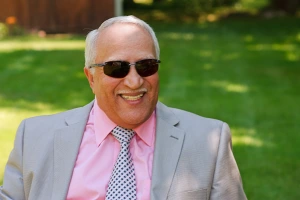
RJ DeBoise

OBITUARY

Richard J. DeBoise, 80, passed away December 26, 2019. Born March 11, 1939 in Palmer, he was the son of James Arthur and Ruth Martha (Andrews) DeBoise. Richard grew up in Palmer and lived in Rhode Island for many years. For the past two and half years, Richard and his wife have lived in Millville, MA. He proudly served his country in the US Air Force from 1955-1957. Before retirement he worked as an electronics technician. He served as union president and business agent for local IBEW 1444. He had been a horse trainer and raced on thoroughbred race tracks in New England, New York, and Canada. He was also a professional drummer. Dick loved sports. He was a big fan of the NY Yankees and New England Patriots. He also enjoyed time at the casino, traveling, golf and building computers. He entertained everyone with stories of his experiences. He lived life to the fullest. He also loved his family.

Dick will be dearly missed by his wife, Teresa (Smith) along with his children, Richard John (Concetta) DeBoise, Jr of Stafford, VA, Michael Anthony (Melody) DeBoise of Dudley, MA, Patricia Ann DeBoise (Geoffrey) Davis of Stafford, VA, Mark (Ingrid) Fisher of Providence, RI, Cleotha “Chris” Grier III of W. Warwick, RI, and Danyel Tina DeBoise (Tim Hadden) Stapleton of Millville, MA. Richard was one of 17 children and is survived by Marie High of Wilbraham, Stewart (Susan Henrichon) DeBoise of Wilbraham, Michael DeBoise of Chicopee, Cortez (Barbara) DeBoise of Palmer, and Christine (Basil) Scott of Springfield, along with 18 grandchildren and 12 great grandchildren. He is also survived by a host of nieces and nephews. Besides his parents, he was predeceased in death by his siblings, James Henry, Ruth, Joseph Francis, William Desmon, Dorothy Blanche, Barbara Rose, Shirley Pearl, Joyce, Morris Wayne, Harry Lewis and Ronald John.

The funeral was held at the Beers & Story Palmer Funeral Home, and burial with military honors was at the MA Veterans’ Memorial Cemetery in Agawam.

A toast to a very full and rich life…….

Teri
Philip Andrews Jr and Philip Andrews Sr

PHILIP ANDREWS JR

As we continue to climb the Andrews branch of the tree, we have almost reached the top of what I have been able to find. The father of CalvinDexterAndrews was PhilipAndrews, Jr.  Philip was a lifelong resident of Ludlow, Massachusetts. He was born about 1808, the son of Philip and Sarah (unknown) Andrews. Philip must have been married twice, since his second wife would have been too young to be the mother of Dexter. He married (2) Mary Ann Powers on January 1,1838 in Ludlow. Mary Ann was eight years old when Calvin Dexter was born, supporting Philip’s relationship with another woman before his marriage to Mary Ann.

Calvin was probably the only child born from Philip’s first marriage. Philip and Mary Ann had one child: Mary Ann Andrews (Jr) was born about 1830, and married George W Mason April 12, 1855.  Philip is listed in the 1840 census with four in the family, one adult male (Philip), one adolescent male (Calvin Dexter), one adult female (Mary Ann Sr.), and a girl under 10 years (Mary Ann Jr.).

Not a lot is known about Philip. He probably worked as a laborer on the farms in Ludlow. Philip died violently at a young age. He was 34 years old when he was accidentally shot to death on October 17, 1842.[1]   I have not found out the details of this death. If someone can find the old newspapers that covered Ludlow during this time period, that might give us more information on what happened. His death occurred only six months after his father’s tragic death.

Mary Ann Powers was born about 1817 in Ludlow. She was the daughter of CharlesJames and Polly (unknown) Powers, and a first cousin of Lovina Jones, the Continue reading “Philip Andrews Jr and Philip Andrews Sr”

Calvin Dexter and Lovina (Jones) Andrews – the Connection to Native American Heritage

Dreamcatcher
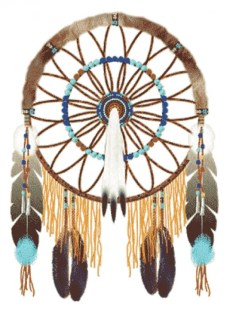
Dream Catcher Image from exemplore.com

Passing on information about the family through oral history is sometimes the only way we have clues to the past. Some of that history proves to be true, other pieces cannot be proven as true or false, and some parts are just plain wrong. Oral history indicated that part of the family was Native American. Charlie Andrews had coppery skin color and high cheek bones, which does not mean you have Native American heritage, but gives you pause. Jimmy DeBoise, son of James, and who spent a lot of time with Charlie and his wife, told us that the family had Native American heritage – he thought Mohawk but wasn’t sure. Richard and I attended our first Pow Wow in Sioux City, South Dakota. One of the dancers looked like one of Richard’s brothers, carried himself the same way, and had the same mannerisms. Again, that doesn’t prove anything, but to me it’s the past calling and waiting to be discovered. Researching the children of Calvin and Lovina verified the Native American heritage when at least one child was identified as Indian on several censuses, and indicated that her father was of Mixed Race. Census takers did not always ask what a person’s race was. Indians were often marked as mulatto or Negro/black. Additionally, Indians were being pushed west so you didn’t always broadcast your heritage. Native American heritage was also verified by DNA results.

Shortly after Calvin and Lovina were born, Andrew Jackson was elected the 7th President of the United States. In 1830, Jackson signed the Indian Removal Act which forcibly removed most Indians in the Southeastern United States to territory West of the Mississippi. The “Trail of Tears”, a phrase coined to describe the forced removal of much of the Cherokee Nation in 1838 in which large numbers of Cherokees died of starvation and disease, is often used to refer to these actions. These removals did not just occur in the Southeastern states. I have found some of my non-Indian family members who had married Native Americans and were living in Indiana also forced to relocate to “Indian Territory” along with their families during this period.

Calvin Dexter Andrews was born March 5, 1825 in Ludlow, Massachusetts, the son of Continue reading “Calvin Dexter and Lovina (Jones) Andrews – the Connection to Native American Heritage”

George W and Jeanette (Freeman) Andrews of Vernon and Manchester, Connecticut

RI 14th Heavy Artillery Battle Flag
RI 14th Heavy Artillery (Colored). Used by regiment during Civil War. Textile collection RI Historical Society rihs.org


When George Washington Andrews, Ruth Andrew’s great grandfather, was born in 1853, the United States was in turmoil over slavery. Franklin Pierce was the 14th President of the United States. Harriet Beecher Stowe had released her bestselling book “Uncle Tom’s Cabin” the year before. When George was four, the Supreme Court issued the Dred Scott decision, stating that slaves are not free when transported from a slave territory to a free territory. They also ruled that Congress could not ban slavery in a U.S. Territory, and that blacks could not be awarded citizenship.

Abolitionists, opposed to slavery, became more vocal. The conflict between pro-slavery and anti-slavery supporters became more violent. John Brown, educated in Massachusetts and Connecticut, became strongly committed to the abolitionist movement while living in Springfield, Massachusetts. He became the leader of violent actions against slaveholders and slave supporters, most known for the Pottawatomie Massacre in Kansas of pro-slavery supporters and the raid on Harper’s Ferry in Virginia while trying to initiate an armed slave revolt. The turmoil of the 1850s led to the Civil War. It was much better to be a black or Indian family living in the North than the South, but life was hard.

In New England, the Industrial Revolution resulted in more factories opening along rivers. The upper Connecticut River Valley experienced the growth of industry, as well as French-Canadian and other immigrants moving to the area to work in the new industries.

George Washington Andrews was born March 25, 1853 in Ludlow, Hampden County, Massachusetts. He was the son of Calvin Dexter and Lovina (Jones) Andrews, and the sixth of 10 children. About the time of his birth, his father left the family and moved to Ellington, Connecticut. Not far from Ludlow, Dexter saw this as an opportunity to ensure his family had a better life. His family received state assistance and was listed on the Ludlow pauper rolls as early as November 1, 1853.[1] Lovina’s family was still living in Ludlow, and provided support for her and her children while her husband was getting established in Connecticut. Her family was from Connecticut, and there was movement back and forth between Massachusetts and Connecticut among family members. Continue reading “George W and Jeanette (Freeman) Andrews of Vernon and Manchester, Connecticut”

The Andrews Family – A New England Heritage

Jim_Ruth_Richard_Harry (2)
Jim, Ruth, Richard, Harry

What was Ruth Martha Andrews’s story? We knew very little about the family’s history, and there were few people to talk to when we began the search for answers. We knew that Ruth’s mother had died at a young age, and Ruth had been raised by her grandparents. We did not know her mother’s name. We did not know who Ruth’s father was, but we did know that her mother had been assaulted by a white man, resulting in a pregnancy. Son Jimmy, who lived with his great grandparents while growing up, told us the family was part Native American, and that he had gone with his great grandparents to “pig roasts” in Connecticut. Son Richard remembered the Civil War artifacts in the attic, and knew that one of his ancestors had fought in the Civil War.

What our search found out was astounding. Ruth has deep roots in New England. Not only did her great grandfather, James Wallace, fight in the Civil War, so did many of her uncles. Her ancestor, Ned Carter, fought in the Revolutionary War along with several of his sons. This family also had roots in New England slavery, which was quite prevalent but never discussed like slavery in the South. Continue reading “The Andrews Family – A New England Heritage”